Convolution
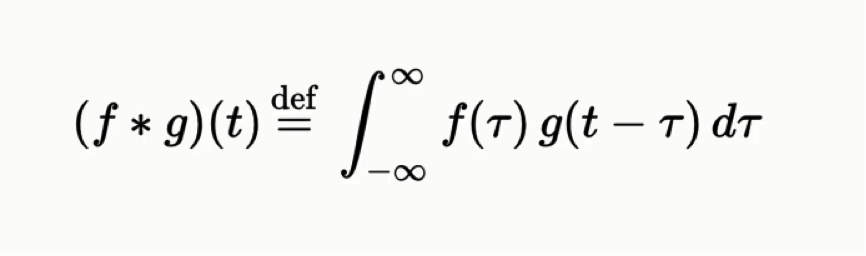
Convolution은
입력에 kernel (=impulse response)을 이용하여
(LTI system의 zero-state) 출력 신호를 계산하는 연산임.
LTI (Linear Time-Invariant) system에서는
- zero-state condition, 즉 initial state가 0인 경우
- system의 input-output 특성이 impulse response로 결정되며,
- 출력은 입력과 impulser response의 convolution 으로 표현됨.
$$
y(t)=x(t)*h(t)
$$
$$
y(t)=\int_{-\infty}^{\infty}x(\tau)h(t-\tau),d\tau
$$
- $x(t)$: input
- $h(t)$: impulse response = convolution kernel
- $y(t)$: zero-state output
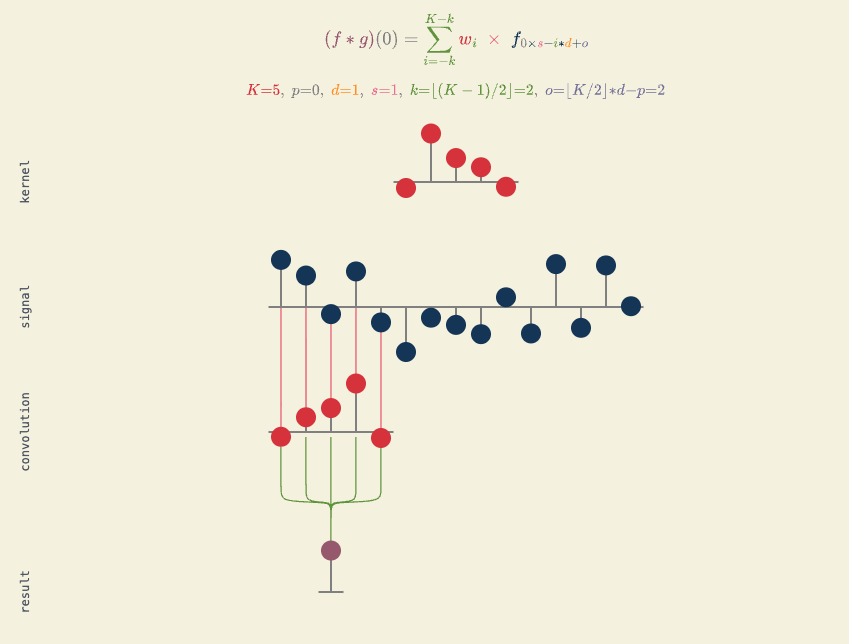
다음은 1d convolution의 동작을 보여줌:
참고: Kernel
kernel은
- integral operator에서
- 입력을 어떻게 가중하여 출력에 반영할지를 결정하는 핵심 함수를 가리키는 용어이며,
- convolution에서는 impulse response가 이 역할을 수행함.
kernel이라는 용어는 여러 분야에서 다양한게 사용됨. 다음을 참고:
https://dsaint31.tistory.com/819#4.%20%EB%8B%A4%EB%A5%B8%20%EB%B6%84%EC%95%BC%EC%9D%98%20Kernel%EA%B3%BC%EC%9D%98%20%EB%B9%84%EA%B5%90-1-5
[ML] Kernel Function 이란: Kernel Trick 포함
Kernel Function이란: 고차원으로의 매핑을 명시적으로 하지 않고도, 그 공간에서의 내적 값(innder product)을 직접 계산할 수 있게 해주는 함수 Kernel Function은머신러닝, 특히 SVM(Support Vector Machine) 과 같
dsaint31.tistory.com
정리
LTI system의 zero-state output은
input과 impulse response(kernel)의 convolution으로 계산됨.
단, 초기 state가 0이 아닌 경우 (즉 zero-state가 아님)에는
- zero-input response가 추가되며,
- 이 경우, 전체 output은 다음과 같이 표현됨.
$$
y(t)=y_{\text{zero-input}}(t)+y_{\text{zero-state}}(t)
$$
- zero-state response는 convolution으로 계산되며,
- zero-input response는 system의 homogeneous response로서 initial condition에 의해 결정됨.
일반적으로 초기 state가 있는 경우 System의 출력은 Differential Equation을 통해 구해짐.
[SS] System 표현하기 : Impulse Response vs. Differential Equation
System 이란?System은 하나의 신호를 다른 신호로 매핑(mapping) 또는 변형(transform)하는 규칙System 표현 (기술, representation)이를 기술하는 가장 좋은 방법은 다음 두가지임.impulse response (h) 를 이용한 표
dsaint31.tistory.com
같이보면 좋은 자료들
2023.08.21 - [.../Signals and Systems] - [SS] Convolution Op.에서 교환법칙 증명.
[SS] Convolution Op.에서 교환법칙 증명.
$$\begin{aligned}y(t)&=x(t)*h(t)\\&=\int^\infty_{-\infty}x(\tau)h(t-\tau)d\tau \\ &=- \int^{-\infty}_\infty x(t-l)h(l) dl \quad\quad \leftarrow l=t-\tau \\ &=- \int^{-\infty}_\infty h(l) x(t-l)dl \\&=\int^{\infty}_{-\infty} h(l) x(t-l)dl\\&=\int^{\infty}_{
dsaint31.tistory.com
2023.08.22 - [.../Signals and Systems] - [SS] Convolution Example : Pulse Function
[SS] Convolution Example : Pulse Function
Pulse function $f(t)$ (blue)와 $g(t)$ (red)의 convolution을 보여주는 gif임. $g(t)$를 reflection시킨 후 slide을 시킴. 검은색 라인이 바로 $(f*g)(t)$의 결과를 보여줌. 둘다 unit pulse이므로 convolution의 결과는 노란색
dsaint31.tistory.com
https://dsaint31.me/mkdocs_site/DIP/cv2/etc/dip_convolution/
BME
convolution filter kernel Convolution 이 문서에서의 convolution은 digital image processing등에서의 convolution을 다루고 있음. signal processing의 discrete convolution에 대한 건 다음 문서를 참고할 것: Discrete Convolution, Cir
dsaint31.me
2022.10.14 - [.../Signals and Systems] - [SS] Cross Correlation
[SS] Cross Correlation
Cross Correlation입력으로 주어진 두 개의 함수(or signal)의 상관관계(correlation), 또는 유사성(similarity) 을 나타내는 함수(or signal)를 반환하는 연산.Cross correlation (흔히 correlation으로도 불림)의 수식은
dsaint31.tistory.com
'... > Signals and Systems' 카테고리의 다른 글
| Shifted Impulse $\delta(t-a)$의 Laplace Transform (0) | 2025.12.03 |
|---|---|
| From Laplace Transform To z-Transform (0) | 2025.12.03 |
| [SS] $u(t)-u(t-a)$ 의 (unilateral) Laplace Transform (0) | 2025.10.30 |
| [SS] 상수 함수에 대한 Unilateral Laplace Transform (0) | 2025.10.30 |
| Lorentzian Function (or Cauchy distribution function) (0) | 2025.10.24 |